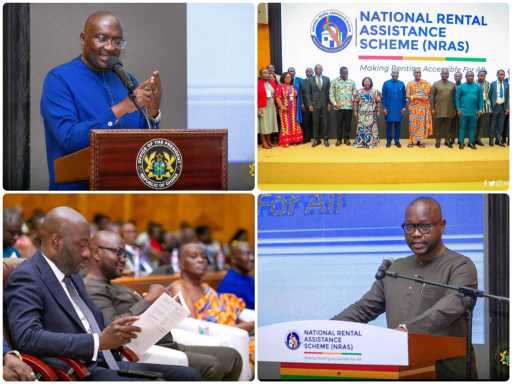
The government of Ghana through the Ministry of Works and Housing has earmarked an amount of Thirty Million Ghana Cedis (GHs 30m) towards the implementation of the National Rental Assistance Scheme (NRAS) aimed at making renting accessible for all Ghanaians.
BACKGROUND:
Residential renting in Ghana has been on an increasing trend for the pst two decades. This is as a result of the higlh demand for affordable rental properties. The problem is compounded by an uncompromising demand of landlords to collect a year or two years of prepaid rent (advance) from potential tenants.
Rescarch has shown that only 5% of Ghana’s
population can acquire their own homes without any form of assistance, with 60% requiring support that is facilitated by the state to access housing whilst 35% Will require additional direct support before they can have access to housing, The assistance required by the houscholds falling into the 60% band comes in the form of supportive regulations and Competitively priced mortgages whereas the lower 35% band need subsidies in addition.
WHAT ARE THE REQUIREMENTS?
To be eligible for the Scheme, the applicant must show proof of the following minimum requirements:
1.Be a Ghanaian
2.Possess a valid Ghana Card
3.Must be an adult of Eighteen (18) years and above
4.Verifiable employment and earned income
5.Must have a verifiable bank statement or mobile money statement
6.Rent payable must not exceed 30 percent of the house -hold income.
H.E. the Vice President, Alhaji Dr. Mahamudu Bawumia, in a keynote speech to officially declare the (NRAS) duly launched, noted that successive governments have instituted several housing policies geared towards increasing access to various housing options across the country.
However, Dr. Bawumia stated that these efforts are mostly concentrated on home ownership services and have not achieved the desired impact in addressing the market imbalances of the rental housing market.
“Globally rental housing forms an integral part of a well functioning housing market and plays a critical role in increasing access to affordable housing options particular for the youth and low income groups,” Dr. Bawumia added.
Speaking further Dr. Bawumia mentioned that as a people focused government, providing meaningful shelter to the citizenry formed a significant part of the NPP government’s development agenda.
One interesting thing about this scheme according to the Vice President, is that when you invest money into the scheme for lending, the repayment that comes in monthly, thus the monthly rent repayment goes back into the pool to be lend again to a new set of renters (tenants).
“Essentially, the scheme is of a pool revolving fund one group of renters as they pay monthly, would be given to a new group of renters making it expand with time,” Dr. Bawumia explained.
I am happy to inform you that government has made significant strides as far as the
housing sector and rent management of the country is concerned. Government through the ministry of Works and Housing has submitted to Parliament for consideration and passage, a rent bill to replace the existing rent of 1963. The current Act was passed by Parliament 59 years ago, and therefore its relevance has been out by the current population growth, urbanisation, housing availability and general trends.
‘This the passage of this act will really enhance the rental market in Ghana and we have the bill in Parliament now,” Dr. Bawumia hinted.
“Additionally, to enhance the service delivery standards of the rent control department, processes have begun in earnest and a service provider has been engaged to digitalize the work of the rent control department across the country.
Digitalization will provide a consolidated platform for the operations of the rent control department, while at the same time improving revenue generation and collection for the country.
‘The implementation of the National Rental Assistance scheme will among other things provide a new pathway for government to leverage its policy functions to streamline the rental sub sector in respect of the quantity and quality of rental housing,” Dr. Bawumia stated.
” I am particularly excited to learn of the eligibility criteria that have been adopted in the selection of beneficiaries of the scheme. It does not only support the call to synchronise all platforms with the national identification system, but also the data produced from the implementation of the scheme will facilitate government’s efforts at expanding the revenue stream flow, improved collection of rent tax.” Dr. Bawumia stressed.
According to Dr. Bawumia, the government has been able to introduce this because of the availability of a national identification system because of the availability of a digital address because of the availability of mobile money interoperability that essentially provides practically all illegible Ghanians with a bank account.
Dr. Bawumia also tasked the Ministry of works and housing not to renege on its oversight and supervisory responsibilities for the successful implementation of the scheme. ” I wish to call on all well meaning Ghanians to support this initiative,” Dr. Bawumia emphasised.
“As a government we remain committed to the successful implementation of the scheme for the benefit of Ghanians,” he said.
The sector Minister, Francis Asenso-Boakye reiterated that, limited land supplies, cost of
capital, rising cost of building materials, among others have all contributed to the high cost of housing developments in the country.
Unfortunately, Mr. Asenso-Boakye recalled, previous housing policies and programmes have often focused on promoting home ownership, neglecting the fact that rental housing is a key component for well functioning housing markets.
Indeed rental accommodation constitute a significant share of shelter services in the country, especially in the urban areas catering for about 35% of households whiles owner Occupied housing accounts for 48% of shelter services in the country.
“In view of the importance of shelter for humanity, the urgent need to provide support for lower income households and the youth to access the minimum standard of decent accommodation cannot be overemphasised,” Mr. Asenso-Boakye observed.
The Minister for Works and Housihg who doubles as the Member of Parliament (MP) for Bantama constituency in the Ashanti Region, pointed out that the initial phase will come in Greater Accra, Ashanti. Northern , Western ,Eastern and Bono-West region were selected because data from rent control indicates that they (above listed region) have a higher rate of rent advance related issues.
The objective of government, however, is to operationalize the scheme throughout the country indeed government recognises the fact that public programmes of this nature may come with its own operational challenges during implementation.
” This notwithstanding, It is our fervent hope that the experiences and lessons learned will help government make the scheme better across the country.,” Mr. Asenso-Boakye assured.
“I am confident that this scheme like all other public programmes of this government will bring a lot of relief to many Ghanians,” he added.
In a solidarity message, Frederick Opoku, General Secretary, National Tenants Union of Ghana, cautioned that the application processes to access the scheme by the people be transparent, fair and credible with no political colours where all qualified applicants under the scheme would have equal opportunity to benefit.
“We believe that such good initiative must include the creation of a stronger consumer regulation regime for rental housing , enhancing tenants’ rights and making it easier to enforce them and making changes to the way complaints are resolved.”
This according Mr. Opoku, will ensure that tenants know exactly how to raise concerns and can be confident their voices will be heard and acted on.
By Kingsley Asiedu
Gov’t Commits GHs 30m To Make Renting Accessible For All
 ghanavoice