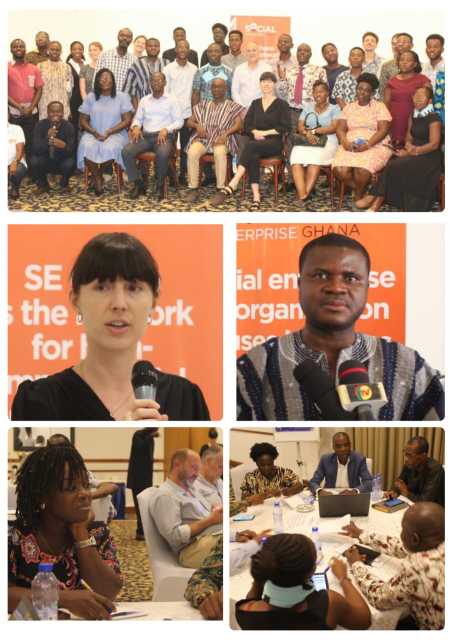
Social Enterprise Ghana (SE Ghana) with support from Deutsche Gesellschaft für Internationale Zusammenarbeit (GIZ) Agribiz programme today organised a one day Research Validation Workshop.
The objectives of the workshop amongs other things is to deliberate on the report “State of Agribusinesses Social Enterprises in Ghana”
The workshop brought together, participants from Academia, Agribusiness Entrepreneurs, Foundees of other social Enterprises as well as stakeholders in the SE ecosystem.
Social Enterprise Ghana (SE Ghana) is an organisation that seeks to bring together all the players in the social enterprise sector in Ghana to build a stronger social enterprise ecosystem and increase its impact.
Presenting the research findings and Methodologies on “State of Agribusiness Social Enterprises” to the attendees of the workshop, Professor Ernest Asamoah, disclosed that the total number of Social Enterprises (SEs) in Ghana as at 2022 is estimated to be One Hundred and Fifteen Thousand Five Hundred (115,500), representing 5.5% of total Micro Small and Medium Enterprises (MSME) prevalent rate.
Explaining further, the researcher who is also a Professor of Risk and Strategy, indicated that 5 out of every 10 MSMEs in the country represents an SE thus; a confirmation of the 5.5% prevalent rate as mentioned earlier.
Touching on contribution of SEs in Ghana, Professor Asamoah pointed out that SEs have created a total of 808,500 Direct Jobs contributing about 3.35% to the Gross Domestic Product (GDP) of the country. Also SEs contribute 3.4 Million Workforce in Ghana as well as 3.4% contribution to Employment and GHs 23.1Billion ($2.6BN) Annual Turnover.
On Challenges, Prof. Asamoah recalled, the major challenge his team encounted were Limited Access to Capital sating more that 60% of SEs have not had access to any form of capital including grant.
“Lack of access to capital is seen as the biggest barrier to growth, followed by
lack of access to grant funding,” he added.
Agribusiness
An estimated 63,294 Social Enterprises are into agribusiness constituting 54.8% of total Social enterprises in Ghana. According the report, a total of Forty Hundred and Forty-three Fifty-five One (443,051) Direct Employment has been created by Agribusiness Social Enterprises out of which
Over 70% of the employees are youth whiles 45% are female working in the Agribusiness Social Enterprises.
Another significant contribution of Agribusiness SEs is 84% contribution to GDP With an estimated USD$ 1.43 Billion contributed to the economy by Social Enterprise Agribusinesses in Ghana also an amount of GHs12.66 BN being annual turnover.
Challenges of Agribusiness Social Enterprises includes;
Low Access to Investors, Lack of Awareness of Social Enterprises, High Interest rate and Cost of Capital to operate SE businesses.
Interview with the media after his presentation, Prof. Asamoah called for the need for a legal regime and recognition in which Social Enterprises can register as such and appropriate policies applied. “This when applied, would lead to SEs obtaijing some lecel of reduction in the 25% tax liability for companies in general,” he stresses.
“We need to move from operating Agriculture as being a way of life thus; “culture” engagement into a business engagement and by so doing, we will be able to use Agriculture to generate business to solve the mirage of environmental and social issues including unemployment,” the lead researcher noted.
For his part, Edwin Zu- Cudjoe, the Executive Director of Social Enterprise Ghana, reiterated that the import of the research is to look at ways that the Agribusiness can be innovated and also bring more inclusivety, making way for more people with disabilities (PWDs), refugees, young people in the Agribusiness space whiles bringing lots of technology innovation into the Agribusiness space to help develop and make Agribusiness very friendly to young people whiles creating more jobs to support in uplifting people from poverty as well as curbing food security issues whiles improving on good nutrition to the vulnerable people in the country.
Mr. Zu- Cudjoe hinted, Agribusiness Social Enterprises need the enabling environment amd support in order to grow and thrive and become sustainable.
The Executive Director of SEG remarked, his outfit believes that this is a very good report for them to use to engage Government Agencies Policy Makers and various Stakeholders to look at how they could support young people to participate in the Agribusiness space.
“We will use this document to engage various ecosystem players so that they can create the enabling environment for Agribusinesses that are Social Enterprises to thrive and grow, “he stressed.
By: Kingsley Asiedu
Social Enterprise Ghana, GIZ Holds Research Validation Workshop
 ghanavoice